Tuesday, 20 March 2018

America Joins The War

Fascinating Historical Photos

Fort Worth USA Bomber
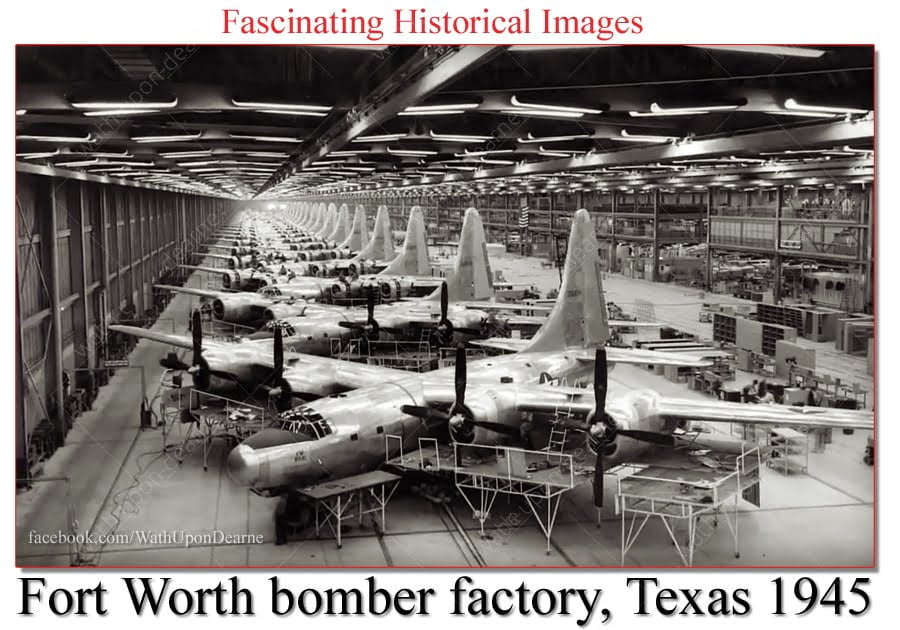


Fort Worth was the manufacturing base for the WW2 acclaimed USA B-24 Liberator Bomber.

The B-24 Liberator was first proposed to the Air Corps in 1938, and with the start of World War II in Europe, the French Government placed an order for 60 aircraft, sight unseen. In 1940, Britain ordered 164. These large foreign orders were placed well before the US military placed similar-sized orders, and played a large role in getting the B-24 project going.

In order to meet the projected demand for the B-24, in early 1941 the government established the Liberator Production Pool Program. Under this program, Consolidated would produce Liberators at the new plant in Fort Worth to supplement the B-24 production in its main San Diego plant. Sub-assemblies and components of B-24Ds would first be sent to Fort Worth and assembled from smaller plants until Fort Worth could produce the complete aircraft.

Three designations of the Liberator, B-24D, B-24E, and B-24G would be flown to Fort Worth from Consolidated production lines in San Diego, Willow Run, Michigan and North American Aircraft in Dallas.

At Fort Worth, the aircraft would be processed though what was called a "modification center" where the aircraft would be updated with the latest modifications before being turned over to the Air Force and flown out from the Fort Worth Army Airfield, which it shared a common airfield with. Over 3,000 B-24 aircraft were manufactured, assembled and modified during the war.

In February 1943, the Army directed Consolidated to shift its production of the B-32 Dominator very heavy bomber from San Diego to Fort Worth, to streamline PBY Catalina production in San Diego for the Navy. The B-32 program, however, was beset with technical problems and by the end of December 1944, only five aircraft had been delivered. In comparison, the B-29 Superfortress had been in combat for nearly six months. Before the program's termination in September 1945, only 124 B-32s were produced in Fort Worth.


Here is another uploaded picture from our numerous archived collections. You can SHARE all our community posts and images. Tell your friends and family to join in and be sure to post your news, events and most of all, your comments to any of the published content which is intended for everyone's enjoyment.

take-me-back-to-facebook

[catlist name=Latest News]

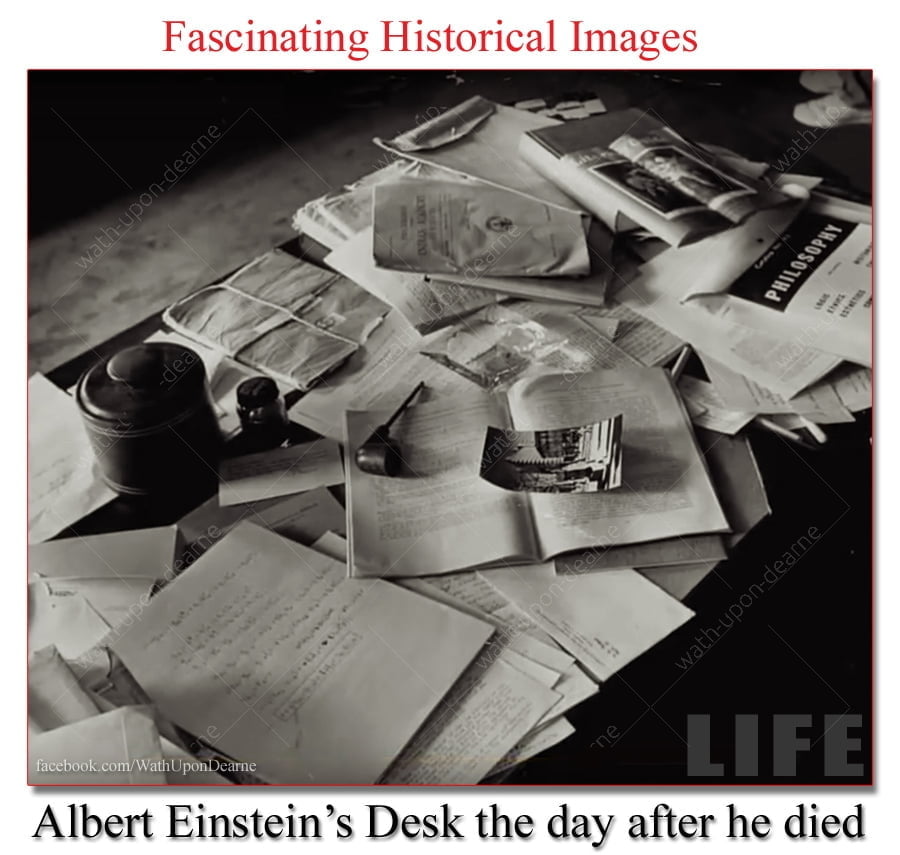
Einstein's Fascinating Work Space

Fascinating Historical Photos

The desk of a Brilliant mind


Albert Einstein (14 March 1879 – 18 April 1955) was a German-born theoretical physicist who developed the theory of relativity, one of the two pillars of modern physics (alongside quantum mechanics). His work is also known for its influence on the philosophy of science. He is best known by the general public for his mass–energy equivalence formula E = mc2 (which has been dubbed "the world's most famous equation"). He received the 1921 Nobel Prize in Physics "for his services to theoretical physics, and especially for his discovery of the law of the photoelectric effect", a pivotal step in the evolution of quantum theory.

Near the beginning of his career, Einstein thought that Newtonian mechanics was no longer enough to reconcile the laws of classical mechanics with the laws of the electromagnetic field. This led him to develop his special theory of relativity during his time at the Swiss Patent Office in Bern (1902–1909), Switzerland. However, he realized that the principle of relativity could also be extended to gravitational fields and—with his subsequent theory of gravitation in 1916—he published a paper on general relativity. He continued to deal with problems of statistical mechanics and quantum theory, which led to his explanations of particle theory and the motion of molecules. He also investigated the thermal properties of light which laid the foundation of the photon theory of light. In 1917, he applied the general theory of relativity to model the large-scale structure of the universe.

Between 1895 and 1914, he lived in Switzerland (except for one year in Prague, 1911–12), where he received his academic diploma from the Swiss Federal Polytechnic in Zürich (later the Eidgenössische Technische Hochschule, ETH) in 1900. He later taught at that institute as a professor of theoretical physics between 1912 and 1914 before he left for Berlin. In 1901, after being stateless for more than five years, he acquired Swiss citizenship, which he kept for the rest of his life. In 1905, he was awarded a PhD by the University of Zürich. The same year, his annus mirabilis (miracle year), he published four groundbreaking papers, which were to bring him to the notice of the academic world, at the age of 26.

He was visiting the United States when Adolf Hitler came to power in 1933 and—being Jewish—did not go back to Germany, where he had been a professor at the Berlin Academy of Sciences. He settled in the United States, becoming an American citizen in 1940. On the eve of World War II, he endorsed a letter to President Franklin D. Roosevelt alerting him to the potential development of "extremely powerful bombs of a new type" and recommending that the U.S. begin similar research. This eventually led to what would become the Manhattan Project. Einstein supported defending the Allied forces, but generally denounced the idea of using the newly discovered nuclear fission as a weapon. Later, with the British philosopher Bertrand Russell, he signed the Russell–Einstein Manifesto, which highlighted the danger of nuclear weapons. He was affiliated with the Institute for Advanced Study in Princeton, New Jersey, until his death in 1955.

Einstein published more than 300 scientific papers along with over 150 non-scientific works. His intellectual achievements and originality have made the word "Einstein" synonymous with "genius". Eugene Wigner wrote of Einstein in comparison to his contemporaries that "Einstein's understanding was deeper even than Jansci von Neumann's. His mind was both more penetrating and more original than von Neumann's. And that is a very remarkable statement."


Here is another uploaded picture from our numerous archived collections. You can SHARE all our community posts and images. Tell your friends and family to join in and be sure to post your news, events and most of all, your comments to any of the published content which is intended for everyone's enjoyment.

take-me-back-to-facebook

[catlist name=Latest News]

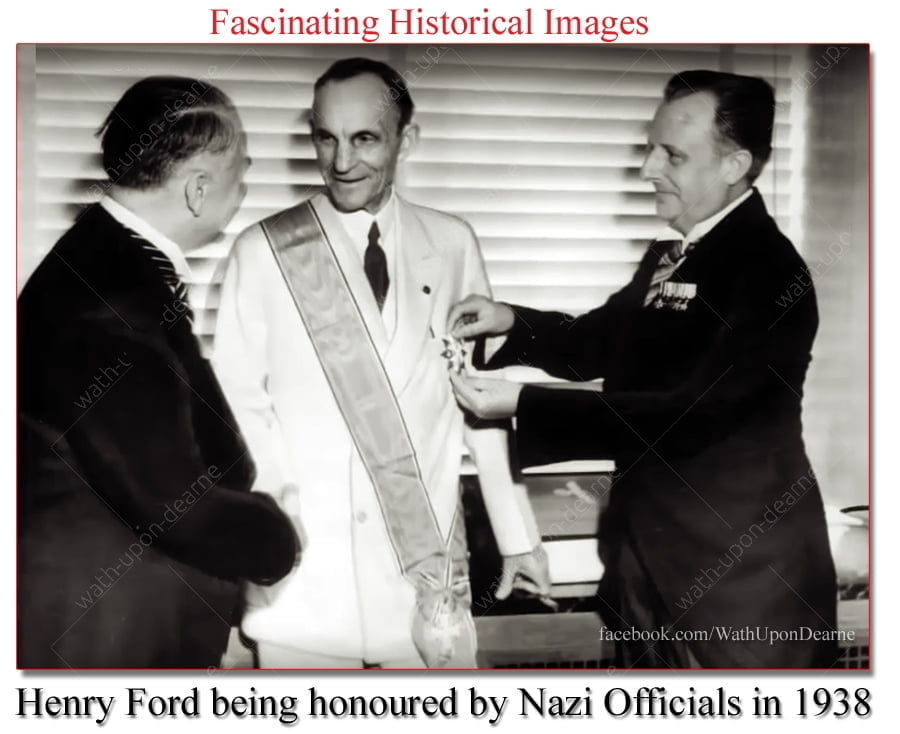
Ford Motors & Nazi Connections

Fascinating Historical Photos

Henry Fords German Links


The Ford company was re-organised in 1939 and changed its name to Ford-Werke.

With the outbreak of the War, car production continued at first with the Taunus being made until 1942 but increasingly military production took over. Ford-Werke built both conventional trucks and Maultier half-tracks for the German armed forces.

Most notably, Ford-Werke manufactured the turbines used in the V-2 rockets.[9] In spite of the heavy bombing of Cologne, the factory got off relatively lightly and after the war production was able to restart in May 1945 with truck manufacture, the US government having paid $1.1 million in consideration of bombing damage.

Ford factory in Saarlouis
Car making restarted in late 1948 with the Taunus. Henry Ford II visited the factory in 1948 during his visit to Germany when he was considering a purchase of Volkswagen, with which he did not ultimately proceed.

In 1952 a new Taunus appeared and this had much in common with the British Ford products and was a great success enabling record production figures to be reached. The company was now being run by Ehrhart Vitger and he spent time recruiting new dealers to replace those lost in East Germany but the company continued to rank third in sales in Germany behind VW and Opel.

Ford began to integrate the operations of its European subsidiaries in the 1960s with the launch of the 1965 Ford Transit panel van, which was a joint development between Ford of Britain and Ford-Werke, however it was the Ford Escort in 1968 that truly marked the end of unique models in European countries and followed the creation of Ford Europe in 1967 from the assets of the British and German operations but the corporate entities continue.

General Motors would later follow Ford's lead in the 1970s by integrating its Opel and Vauxhall subsidiaries into GM Europe.


Here is another uploaded picture from our numerous archived collections. You can SHARE all our community posts and images. Tell your friends and family to join in and be sure to post your news, events and most of all, your comments to any of the published content which is intended for everyone's enjoyment.

take-me-back-to-facebook

[catlist name=Latest News]

The Bombing Of London WW2

Fascinating Historical Photos

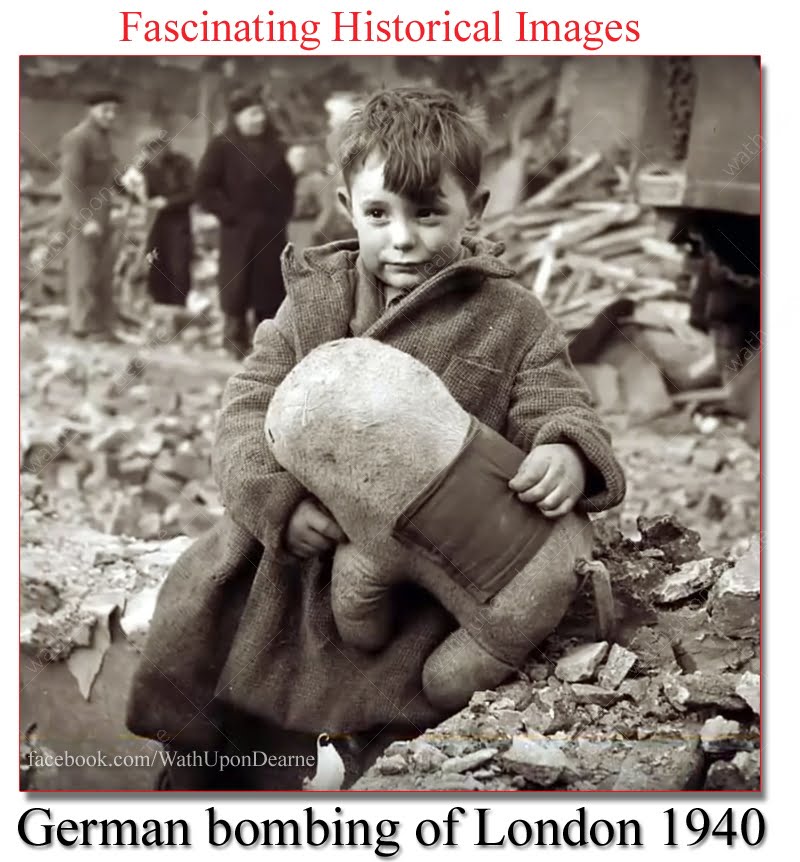
A lost boy & his toy


The Blitz was a German bombing offensive against Britain in 1940 and 1941, during the Second World War. The term was first used by the British press and is the German word for 'lightning'.

The Germans conducted mass air attacks against industrial targets, towns and cities, beginning with raids on London towards the end of the Battle of Britain in 1940, a battle for daylight air superiority between the Luftwaffe and the Royal Air Force over the United Kingdom.

By September 1940, the Luftwaffe had failed and the German air fleets (Luftflotten) were ordered to attack London, to draw RAF Fighter Command into a battle of annihilation.

Adolf Hitler and Reichsmarschall Hermann Göring, commander-in-chief of the Luftwaffe, ordered the new policy on 6 September 1940.

From 7 September 1940, London was systematically bombed by the Luftwaffe for 56 out of the following 57 days and nights.


Here is another uploaded picture from our numerous archived collections. You can SHARE all our community posts and images. Tell your friends and family to join in and be sure to post your news, events and most of all, your comments to any of the published content which is intended for everyone's enjoyment.

take-me-back-to-facebook

[catlist name=Latest News]

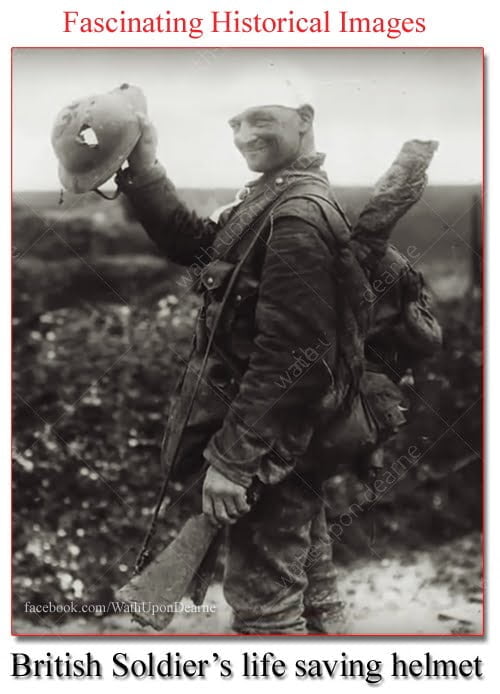
Soldier shows his lucky helmet

Fascinating Historical Photos

Saved by his helmet


World War I, also known as the First World War, the Great War, or the War to End All Wars, was a global war originating in Europe that lasted from 28 July 1914 to 11 November 1918. More than 70 million military personnel, including 60 million Europeans, were mobilised in one of the largest wars in history.

Here is another uploaded picture from our numerous archived collections. You can SHARE all our community posts and images. Tell your friends and family to join in and be sure to post your news, events and most of all, your comments to any of the published content which is intended for everyone's enjoyment.

[catlist name=Latest News]

Fascinating Historical Photos

15 Kiloton Explosion


Here is another uploaded picture from our numerous archived collections. You can SHARE all our community posts and images. Tell your friends and family to join in and be sure to post your news, events and most of all, your comments to any of the published content which is intended for everyone's enjoyment.

take-me-back-to-facebook

[catlist name=Latest News]

Friday, 9 March 2018

Test Post from Wath-upon-Dearne Community Website

Test Post from Wath-upon-Dearne Community Website
http://wath-on-dearne.com/wathondearne